
Renting Party Furniture for Backyard Weddings: 2026 Guide
Table of Contents
Renting Party Furniture for Backyard Weddings: Where to Start
Your Wedding Rental Checklist: What to Reserve and When
Core Items Every Backyard Wedding Needs
How Far in Advance to Book
How Many Chairs for a Wedding: Seating Math That Works
Backyard Wedding Seating Layout: Arranging Tables and Chairs
Ceremony vs. Reception Configurations
Wedding Tent Rentals: When You Need Coverage
When a Tent Stops Being Optional
Placement and Wind
Rain Plan Basics
Measuring Your Backyard Before You Order
1. Usable Flat Area
2. Table and Canopy Footprints
3. Delivery Path
4. Obstacles and Utilities
Delivery, Setup, and What to Expect on Event Day
Frequently Asked Questions
Last Updated: October 14, 2026
Renting Party Furniture for Backyard Weddings: Where to Start
Renting party furniture for backyard weddings comes down to three numbers: your guest count, your available space, and your budget. Nail those first, and the rest of your order writes itself.
At Sharp Event Rentals, we handle tables, chairs, and tents for backyard celebrations across Clermont and Hamilton counties every season. The hosts who have the calmest event days are the ones who measured their yard and reserved early. That's the whole game.
Here's the part most guides skip: your backyard is not a venue. It has a septic field, a slope, a garden bed, and one narrow gate. Every rental decision flows from those constraints, not from a Pinterest board.
Below, we'll walk through what to reserve, how many chairs you actually need, how to lay out seating, and when a tent stops being optional. The CDC guidance on outdoor event gatherings is a useful starting point for thinking through crowd flow in residential spaces.
Key Takeaway Guest count, yard measurements, and budget come before style. Order in that sequence and you'll avoid the two most common rental mistakes: too few seats and a tent that won't fit.
Your Wedding Rental Checklist: What to Reserve and When
A backyard wedding rental checklist has two layers: the core items almost every event needs, and the booking timeline that keeps them available.
Core Items Every Backyard Wedding Needs
Start here. These are the items that show up at nearly every backyard wedding we deliver:
Seating: white resin folding chairs
Tables: 60" round tables for guests, 6-ft rectangular tables for food and gifts
Coverage: a 10x20 canopy tent if weather or sun is a concern
Add-ons: coolers for drinks
Linens, dinnerware, and floral decor come from other vendors. We focus on the structure your event sits on.

How Far in Advance to Book
Reserve four to six weeks out for a standard backyard wedding. Peak season, roughly May through September, pushes that to eight to twelve weeks. Holiday weekends go faster.
A common mistake is waiting until the guest count is final. Book the furniture first with a working number, then adjust quantities closer to the date.
Pro Tip Book your tent before your chairs. Tents are the item most likely to sell out on a popular weekend, and once you know the tent footprint, your seating layout falls into place around it.
How Many Chairs for a Wedding: Seating Math That Works
The short answer: order one chair per guest, plus a small buffer. For a seated dinner, that means one chair for every place setting.
Here's the math that trips people up. A 60" round table seats eight comfortably. Ten guests at a 60" round is tight, and twelve is a squeeze nobody enjoys.
For rectangular seating, a 6-ft rectangular table seats six to eight depending on how you arrange place settings.
Guest Count | Chairs Needed | |
40 | 5 | 40 |
64 | 8 | 64 |
80 | 10 | 80 |
100 | 13 | 100 |
Add a few extra chairs for the head table, vendors, and anyone who arrives unannounced. Ordering 5 to 10 percent above your confirmed count is standard practice.

Watch Out Ordering exactly to your RSVP count is the single most common seating mistake. Guests bring plus-ones, and a missing chair means someone stands through dinner. A small buffer costs far less than a scramble on event day.
Backyard Wedding Seating Layout: Arranging Tables and Chairs
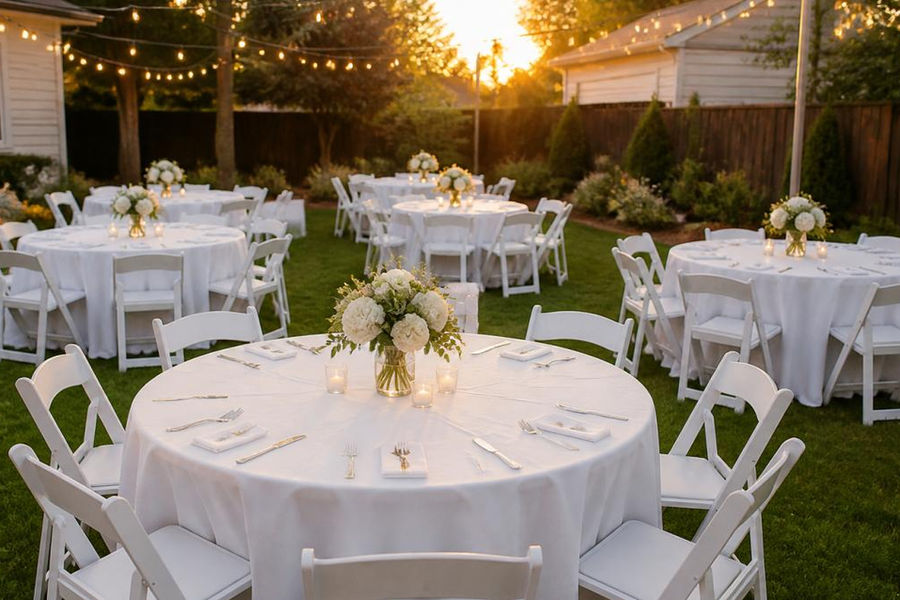
A backyard wedding seating layout works best when you separate ceremony seating from reception seating, even if both use the same chairs.
Ceremony vs. Reception Configurations
For the ceremony, arrange chairs in rows facing a focal point, whether that's an arch, a tree, or a view. Leave a center aisle wide enough for two people to walk side by side.
For the reception, round tables create conversation. Rectangular tables suit long, family-style dinners. Leave at least three feet between tables so guests and servers can move freely.
If your ceremony and reception share a space, plan for a flip. Either your rental company reconfigures the seating during cocktail hour, or you set ceremony chairs on one side and reception tables on the other.
Best For Backyards with a clear focal point and a flat lawn. Sloped or heavily landscaped yards need a site visit before you commit to a layout.
Wedding Tent Rentals: When You Need Coverage
Wedding tent rentals stop being optional the moment weather enters the conversation. But "rent a tent" is not a plan. What matters is which canopy you reserve, where it goes, and what it can realistically cover.
We carry the 10x20 canopy. It solves different problems.

10x20 canopy, a long, rectangular footprint. Best for covering a food station, a buffet line, a gift and card table, or a bar running end to end. It also works as a narrow ceremony backup if your seating rows are shallow.
Neither canopy is a full-wedding rain solution for a large seated dinner. If your guest list is big enough that you're renting ten 60" round tables, a single canopy will not cover them. The honest move is to plan multiple canopies zoned over critical areas, food, bar, cake, DJ, and let guests shelter indoors or under the house overhang if rain hits.
When a Tent Stops Being Optional
You need at least one canopy if any of these apply:
Rain is plausible during your event month
Your yard has no natural shade and you're serving food that shouldn't sit in direct sun
You want a defined, anchored space for the bar, cake, or DJ
Your rental items, linens, dinnerware, electronics, need a dry home base
Placement and Wind
Placement is where most backyard tent plans fall apart. A canopy needs a flat, level patch. On a slope, legs sit at different heights, the frame twists, and the canopy becomes unstable in wind.
Walk your yard and pick spots that are:
Flat and firm, not soggy or freshly seeded
Clear of low branches, gutters, and roof drip lines
Away from the grill, fire pit, and any open flame
Reachable by the delivery crew without crossing a flower bed or a septic field
Wind is the real risk with any canopy. A 10x20 or 12x12 acts like a sail once it's up. Stake or weight every leg, and if high wind is forecast, take the canopy down rather than leave it up overnight. A collapsed canopy is a safety issue, not just a decor problem.
Rain Plan Basics
A workable rain plan has three parts:
A dry zone, canopies over food, bar, cake, and DJ.
An indoor fallback, a garage, covered porch, or house interior where guests can move if the sky opens.
A decision deadline, pick a time (often the morning of) when you either commit to the outdoor layout or shift to the fallback.
Watch Out Do not treat a single canopy as full rain coverage for a seated dinner. Canopies protect zones, not entire guest lists. Plan the dry zones first, then decide what happens to everyone else if it rains.
Measuring Your Backyard Before You Order
Measure before you order, always. A backyard is not a venue, it has a septic field, a slope, a garden bed, and one narrow gate. Every rental decision flows from those constraints.
Grab a tape measure and a notebook. You are mapping four things.
1. Usable Flat Area
Measure the largest rectangle of flat, firm ground where guests will actually sit or stand. Ignore the sloped corner, the garden bed, and the muddy patch by the downspout. That flat rectangle is your real venue.
2. Table and Canopy Footprints
Once you know your flat area, translate it into furniture:
A 60" round table needs roughly a 10-foot circle of space once chairs are pulled out, about 5 feet for the table and chairs, plus clearance behind them for guests to push back and walk.
A 6-ft rectangular table seats six to eight and needs about 3 feet of walking clearance on the serving side.
A 10x20 canopy needs a 10-by-20 footprint plus a few feet on each side for staking and access.
Sketch your flat area on paper, then lay out tables and canopies inside it. If they don't fit on paper, they won't fit in the yard.
3. Delivery Path
This is the step hosts skip, and it's the one that cancels setups. Measure:
Gate width, the narrowest point a table, chair stack, or canopy frame has to pass through
Path surface, gravel, grass, mud, and steps all slow or block a hand truck
Turns, a tight corner between the gate and the setup area can stop a long table
Overhead clearance, low branches and gutters catch canopy frames
Walk the route a delivery crew would take, from the street to the setup spot, and note every pinch point. A canopy that can't reach the lawn can't be set up, no matter how much yard is behind the gate.
4. Obstacles and Utilities
Mark anything the crew must avoid or work around:
Septic lids and leach fields
Sprinkler heads and irrigation lines
Buried electrical, gas, or cable lines
Tree roots, stumps, and low-hanging branches
Patio edges, retaining walls, and steps
Photograph these from a few angles and bring the photos to your booking. It helps your rental provider spot obstacles you might overlook.
Pro Tip Your sketch becomes your order sheet. Guest count, flat area, table footprints, and delivery path, write them all down before you reserve anything. It's the difference between a smooth setup and a morning-of scramble.
Delivery, Setup, and What to Expect on Event Day
A reliable rental experience runs on a simple three-step process: reserve online with a deposit, confirm your delivery or pickup window, and let the crew handle setup.
We offer local pickup in Bethel, Ohio, delivery to your address, and full professional setup.
What should you prepare before the crew arrives? Clear the setup area of vehicles, pets, and loose items.
One customer put it simply: "Such a seamless experience and a great small business. I would use them again and wouldn't even hesitate.
That's the standard we aim for on every order.
Planning a backyard wedding means juggling a hundred details, and furniture shouldn't be one you lose sleep over.
Frequently Asked Questions
What furniture do you need to rent for a backyard wedding?
Most backyard weddings need chairs for the ceremony and reception, tables for dining and food service, and a tent for weather coverage. For a typical 100-guest wedding, that means around 100 chairs, 12 to 13 round tables for seating, plus 2 to 3 rectangular tables for the buffet, gifts, and cake. A 10x20 canopy tent covers food stations or a small gathering area. Add cocktail tables for mingling and coolers for drinks. Build your list around your guest count and venue layout.
How many tables and chairs do you need for a backyard wedding?
Plan for one chair per guest plus a few extras for vendor meals or late additions. For tables, a 60-inch round seats 8 guests comfortably, so 100 guests need about 13 round tables. Add 2 to 3 six-foot rectangular tables for food, drinks, gifts, and the cake. If you are hosting a buffet, add one more rectangular table for the serving line. Always round up rather than down. Running short on seating is far worse than having a few unused chairs.
Should you rent a canopy tent for a backyard wedding?
A canopy tent protects guests and food from rain, direct sun, and wind, which matters for any outdoor event. A 10x20 canopy comfortably covers a food station, gift table, or small seating area. If your reception includes dining tables, you may need multiple canopies or a larger tent setup. Even with a favorable forecast, having coverage reduces stress and keeps the event comfortable. Reserve your tent at the same time you book chairs and tables so everything arrives together.
What should you measure before renting tables and chairs?
Measure the flat, usable area of your backyard, not the full property line. Note the dimensions of your patio, lawn, or deck where guests will actually sit. Check for slopes, tree roots, sprinkler heads, and low-hanging branches that affect table placement or tent setup. Measure gate widths and pathways so delivery crews can move equipment in. Knowing your space prevents ordering furniture that will not fit and helps you plan a layout that flows well for guests.
White Resin Folding Chair


Comments